Artificial Intelligence (AI) is often spoken about as a single technology, but in reality it’s an umbrella term covering multiple systems and techniques. At the core of most modern AI solutions lies machine learning—the engine that allows AI to learn, adapt, and improve over time.
Understanding machine learning is essential to understanding how AI actually works, why it’s so powerful, and how businesses can use it effectively.
What Is Machine Learning?
Machine learning (ML) is a branch of AI that enables systems to learn from data rather than follow rigid, pre-programmed rules.
Instead of being told exactly what to do, a machine learning system:
Analyses data
Identifies patterns
Makes predictions or decisions
Improves with experience
This ability to learn is what separates modern AI from traditional software.
Why Machine Learning Is Central to AI
Without machine learning, AI would be limited to static, rule-based behaviour. ML gives AI its intelligence by allowing it to:
Adapt to new data
Improve accuracy over time
Handle complexity and variability
Make probabilistic decisions rather than fixed ones
In short, machine learning is how AI understands the world.
How Machine Learning Works (In Simple Terms)
At a high level, machine learning follows a simple cycle:
Data Input – The system is fed large amounts of data
Training – Algorithms analyse patterns within that data
Model Creation – A predictive model is formed
Testing & Refinement – Results are evaluated and improved
Deployment – The model is used in real-world scenarios
The more relevant data the system processes, the better it becomes.
Key Types of Machine Learning
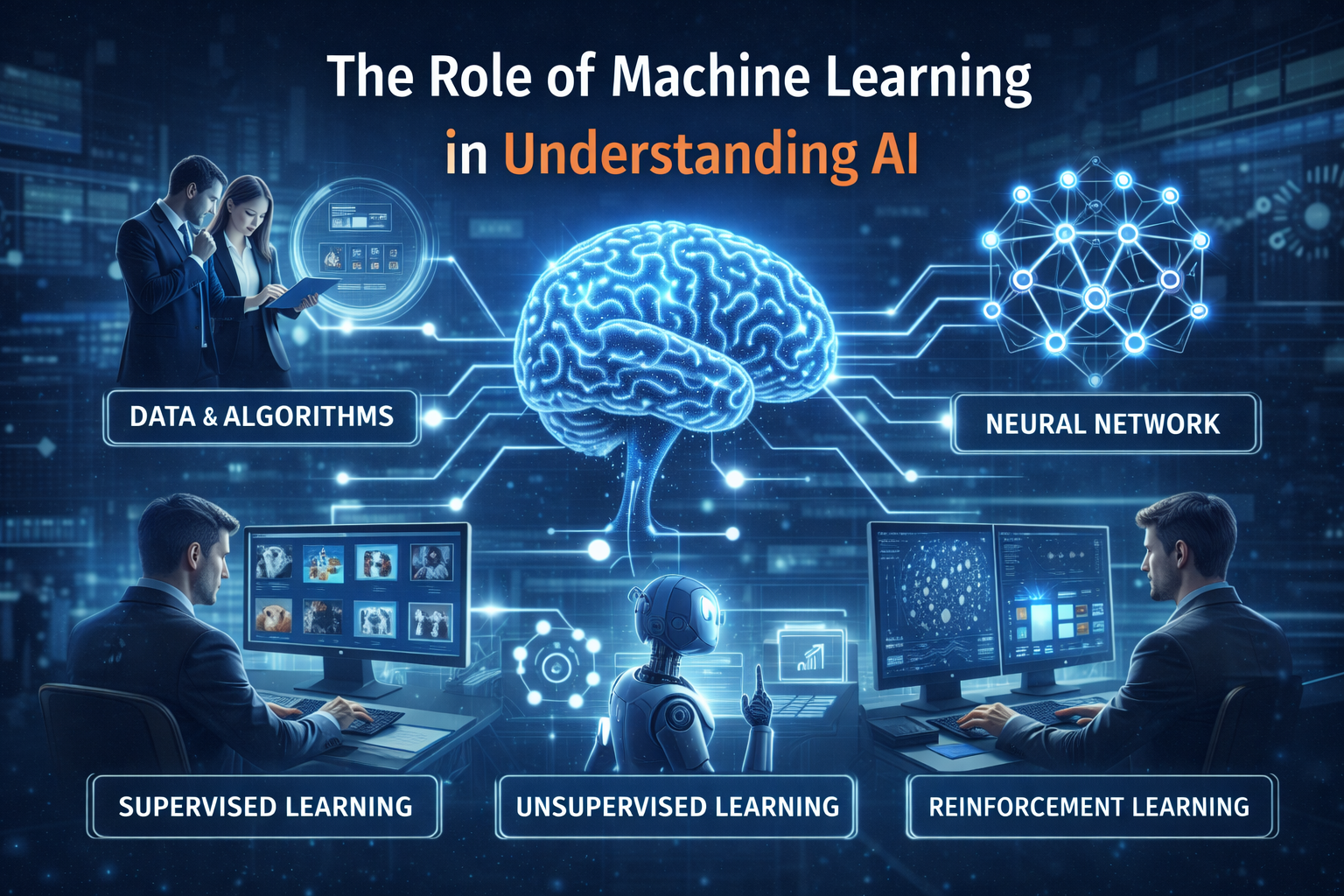
1. Supervised Learning
In supervised learning, the model is trained on labelled data—where the correct output is already known.
Common uses include:
Email spam detection
Image recognition
Sales forecasting
This is one of the most widely used ML approaches in business today.
2. Unsupervised Learning
Unsupervised learning works with unlabelled data, identifying hidden patterns or groupings.
It’s often used for:
Customer segmentation
Behaviour analysis
Market trend discovery
This helps businesses uncover insights they didn’t know to look for.
3. Reinforcement Learning
Reinforcement learning allows systems to learn through trial and error, improving performance based on feedback.
This approach powers:
Recommendation engines
Robotics
Game-playing AI
Advanced optimisation systems
It’s particularly effective in complex, dynamic environments.
Machine Learning’s Role in Business AI
Machine learning enables AI tools to move beyond automation into intelligent optimisation.
In business contexts, ML helps:
Predict customer behaviour
Optimise marketing performance
Improve content recommendations
Detect anomalies and risks
Personalise user experiences
Instead of reacting to events, businesses can anticipate them.
Understanding AI Through the Lens of Machine Learning
Many misunderstandings about AI come from not recognising the role of machine learning.
AI does not:
Think like humans
Possess consciousness
Make decisions without data
What it does is:
Analyse patterns at scale
Learn from historical information
Optimise outcomes based on probabilities
Machine learning is the mechanism that makes this possible.
The Importance of Quality Data
Machine learning models are only as good as the data they learn from.
High-quality AI systems depend on:
Accurate data
Relevant datasets
Ongoing refinement
Ethical data usage
This is why successful AI adoption focuses as much on data strategy as it does on tools.
The Future of Machine Learning and AI
As machine learning techniques continue to evolve, AI systems will become:
More accurate
More context-aware
More personalised
More accessible to non-technical users
This will further integrate AI into everyday business operations—often invisibly, working quietly in the background.
Final Thoughts
To truly understand AI, you must understand machine learning.
Machine learning is what allows AI to:
Learn instead of follow rules
Improve instead of stagnate
Adapt instead of repeat
For businesses, this means smarter systems, better decisions, and scalable growth—without adding complexity.
As AI becomes standard across industries, machine learning will remain the foundation that makes intelligent automation possible.
Interested in applying AI and machine learning in practical, business-friendly ways?
Explore how intelligent automation works in real-world systems at www.theaiautoposter.com and see how AI can support your growth—quietly and consistently.